

Number of Sick People Rising Rapidly

According to the data obtained by the National Public Health Centre, the number of cases of influenza, acute upper respiratory infections (ARIs) and COVID-19 was increasing further last week. During 20-26 November (week 47) the overall incidence of the diseases was 1404.1 cases/ 100 000 population, compared to 1183.6 cases/ 100 000 population the week before (week 46).
The lowest incidence of influenza, ARI and COVID-19 last week was recorded in Utena County, while the highest was recorded in Vilnius County. Epidemic level, i.e. 1 500 cases/ 100 1000 population was reached in seven Municipalities: Vilnius City and District, Marijampolė, Kazlų Rūda, Klaipėda City, Kaunas District and Jonava District.
On 26-26 November, 17 people were hospitalised in the country due to influenza: 8 children (0-17 years), 1 person aged 18-64 years, and 8 persons aged 65+ years. 2 persons (aged 65+) required admission to the intensive care unit (ICU).
Data on incidence of influenza, ARI and COVID-19 in Counties
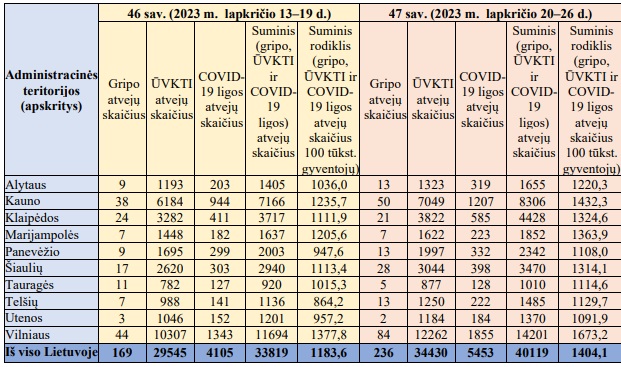
According to the data from the National Public Health Care Laboratory, a total of 105 specimens were taken from patients with symptoms of ARI in week 46 /2023, 3 of which tested positive for influenza type A virus.
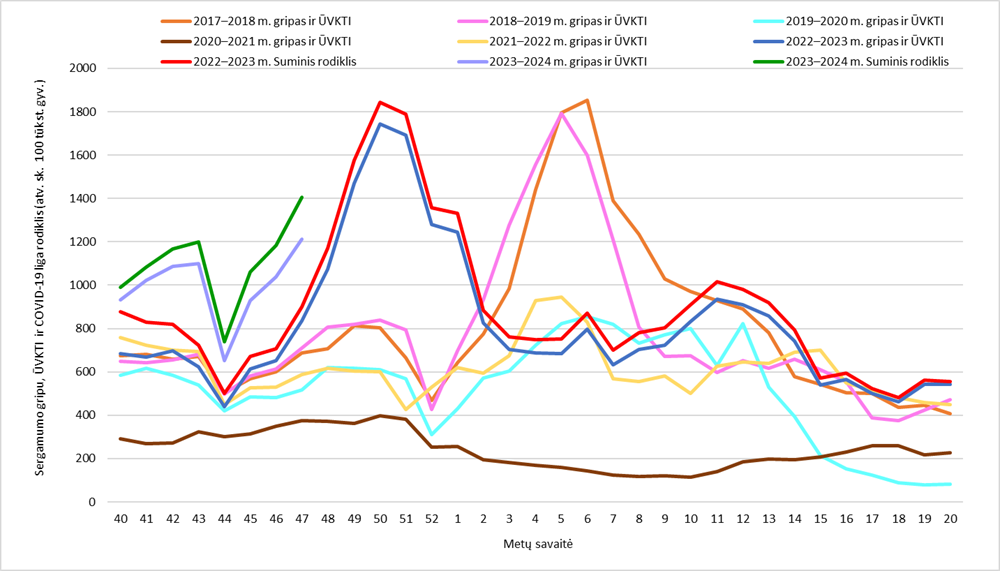
By the end of week 46 (ending 19 November 2023), rates of respiratory illness (influenza-like illness (ILI) and/or acute respiratory infection (ARI)) in the community were increasing in many EU/EEA countries as expected for this time of the year. SARS-CoV-2 continued to circulate at higher levels than seasonal influenza and respiratory syncytial virus (RSV). The prevalence of ARIs (excluding influenza and COVID-19) in Lithuania and Latvia in week 46 was assessed as average.
The NPHC reminds the inhabitants that the most effective way to protect themselves from influenza and COVID-19 is vaccination. If you have not got your vaccine yet, you still have a possibility to get vaccinated, and do so at one visit to your doctor. Getting both vaccines is especially recommended for people at greater risk:
- 65 years and older; People living in nursing homes;
- people with chronic illnesses;
- immunocompromised persons;
- health care workers;
- pregnant women.
Hygiene rules are also very important to protect against influenza and colds: cover your nose and mouth with a disposable tissue when sneezing and coughing. Throw the used tissues into the trash. If you don't have a tissue, cough or sneeze into your elbow, not your hands. If you cover your mouth and nose with your palm, wash your hands immediately; wash your hands regularly with soap and water or use hand sanitizers; avoid touching your eyes, nose and mouth, especially with unclean hands; ventilate and clean your premises with a damp cloth frequently; wear medical face masks or respirators in enclosed public places (service areas, events, places of worship, public transport and other areas that are poorly ventilated and crowded and where it is not possible to keep a safe distance from other people).
Last updated: 28-11-2023
Related news:
The Second Peak of Tick Activity Begins in Autumn
NPHC: Don’t forget about tetanus protection when working outdoors
Preserving Season Is in Full Swing: NPHC Warns of the Hidden Risk of Botulism
The Start of the School Year Is the Right Time to Check Your Child’s Vaccinations
On World Mosquito Day, NPHC Reminds Travellers to Protect Themselves Against Mosquito Bites