

More Municipalities Reach Epidemic level
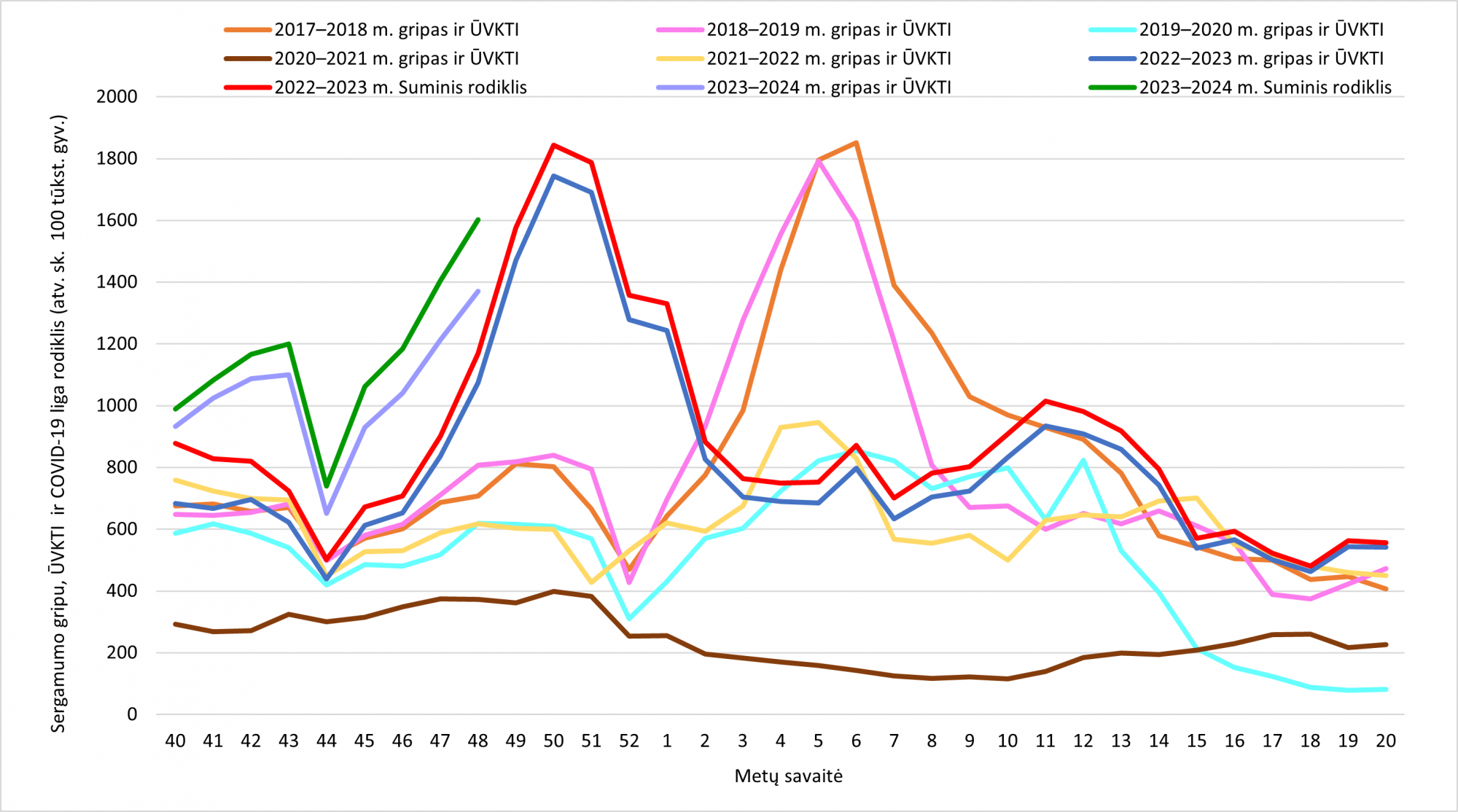
According to the data obtained by the National Public Health Centre, the number of cases of influenza, acute upper respiratory infections (ARIs) and COVID-19 is increasing every week. In week 48 of the year (27 November - 3 December), the overall incidence rate was 1603.0 cases per 100 000 inhabitants, compared to 1404.1 cases per 100 000 inhabitants in week 47 (20-26 November). The lowest incidence rate last week was recorded in Panevėžys County, while the highest was recorded in Vilnius County.
Currently, an increase in morbidity is being recorded not only in Lithuania but also in other Baltic States.
Over the period of 27 November - 3 December, 22 municipalities crossed the epidemic level of morbidity, defined as more than 1 500 cases per 100 000 population. NPHC specialists liaise with Municipal representatives, who report that the situation in educational establishments and personal health care facilities (PHCFs) is not unusual. No Municipality has declared an epidemic so far. In deciding whether to declare an epidemic, additional criteria, such as hospital admissions, emergency services and ICU bed occupancy due to influenza and/or COVID-19, must also be taken into account.
In the event of declaring epidemic either at municipal or national level, the following measures would apply:
Reinforcement of infection control measures in PHCFs and social care facilities:
- Wearing of medical masks or respirators shall be regulated in accordance with the procedure established by the head of the establishment;
- Separation of patient/population flows (patients with influenza, COVID-19 and ARI from other patients/population);
- provision of home-based personal healthcare services for patients with influenza or COVID-19;
- restriction of visiting patients/residents or mandatory wearing of masks when visiting in accordance with the internal procedures of the establishment;
- recommendation to wear masks in the premises of the establishment for all persons in the establishment.
- Temporary restrictions on mass events (cancellation of events or limitation of the number of spectators) may apply.
- Temporary restrictions in educational establishments may be applied by declaring restrictive measures to control over infection (when education is no longer face-to-face). There are criteria and the possibility to declare restrictions at the level of the individual classroom or the whole establishment.
- Additional infection control measures are recommended (hand hygiene, ventilation, wet room cleaning, wearing masks in closed spaces, etc.).
Last week, 18 people were hospitalised in the country due to influenza: 11 children (0-17 years) and 7 people over 65 years. 1 person (under 2 years of age) was treated in the intensive care unit.
Data on incidence of influenza, ARI and COVID-19 in Counties
Administracinės teritorijos (apskritys) | 47 sav. (2023 m. lapkričio 20–26 d.) | 48 sav. (2023 m. lapkričio 27 d.–gruodžio 3 d.) | ||||||||
Gripo atvejų skaičius | ŪVKTI atvejų skaičius | COVID-19 ligos atvejų skaičius | Suminis (gripo, ŪVKTI ir COVID-19 ligos) atvejų skaičius | Suminis rodiklis (gripo, ŪVKTI ir COVID-19 ligos atvejų skaičius 100 tūkst. gyventojų) | Gripo atvejų skaičius | ŪVKTI atvejų skaičius | COVID-19 ligos atvejų skaičius | Suminis (gripo, ŪVKTI ir COVID-19 ligos) atvejų skaičius | Suminis rodiklis (gripo, ŪVKTI ir COVID-19 ligos atvejų skaičius 100 tūkst. gyventojų) | |
Alytaus | 13 | 1323 | 319 | 1655 | 1220,3 | 11 | 1383 | 384 | 1778 | 1311,0 |
Kauno | 50 | 7049 | 1207 | 8306 | 1432,3 | 56 | 8131 | 1419 | 9606 | 1656,5 |
Klaipėdos | 21 | 3822 | 585 | 4428 | 1324,6 | 49 | 4504 | 750 | 5303 | 1586,4 |
Marijampolės | 7 | 1622 | 223 | 1852 | 1363,9 | 12 | 1758 | 257 | 2027 | 1492,8 |
Panevėžio | 13 | 1997 | 332 | 2342 | 1108,0 | 10 | 2143 | 406 | 2559 | 1210,6 |
Šiaulių | 28 | 3044 | 398 | 3470 | 1314,1 | 52 | 3575 | 543 | 4170 | 1579,2 |
Tauragės | 5 | 877 | 128 | 1010 | 1114,6 | 12 | 1042 | 169 | 1223 | 1349,6 |
Telšių | 13 | 1250 | 222 | 1485 | 1129,7 | 9 | 1491 | 281 | 1781 | 1354,9 |
Utenos | 2 | 1184 | 184 | 1370 | 1091,9 | 8 | 1313 | 265 | 1586 | 1264,1 |
Vilniaus | 84 | 12262 | 1855 | 14201 | 1673,2 | 101 | 13477 | 2191 | 15769 | 1858,0 |
Iš viso Lietuvoje | 236 | 34430 | 5453 | 40119 | 1404,1 | 320 | 38817 | 6665 | 45802 | 1603,0 |
According to the National Public Health Care Laboratory, a total of 59 specimens were taken from patients with symptoms of ARI in week 47 /2023, 14 of which tested positive for type A virus and 1 for respiratory syncytial virus (RSV).
According to the European Respiratory Virus Surveillance Summary (ERVISS), by y the end of week 47 (ending 26 November 2023), rates of respiratory illness (influenza-like illness (ILI) and/or acute respiratory infection (ARI)) in the community were increasing in many EU/EEA countries. Rates of severe acute respiratory infection (SARI) cases presenting to secondary care were comparable to the same time last year.
SARS-CoV-2 continued to circulate at higher levels than seasonal influenza and respiratory syncytial virus (RSV).
Vaccination rates are increasing - it's not too late to get the vaccine
Since September, 204 509 people have been vaccinated with the seasonal flu vaccine. Since 5 October, 44 747 people have been vaccinated with COVID-19. There is still a possibility to get the flu vaccine and the COVID-19 vaccine at one visit to your doctor. For a list of treatment facilities that have ordered the vaccines, click here.
We strongly recommend that people at risk (65 years and older; people living at social care and nursing homes; people with chronic diseases or a weakened immune system; healthcare workers; pregnant women) are vaccinated.
The NPHC urges people to follow hygiene rules to protect themselves against influenza and other colds: cover your nose and mouth with disposable tissues when coughing and sneezing (or with a handkerchief or bent elbow); wash hands regularly with soap and water or use hand sanitisers, especially after coughing or sneezing; avoid touching eyes, nose and mouth, especially with unclean hands; wet-clean and ventilate rooms frequently; wear medical face masks or respirators in enclosed public spaces (places of service, houses of worship, public transport and other closed and crowded indoor settings and where it is not possible to keep a safe distance from other people). If you feel flu-like symptoms (fever, cough, sore throat, headache, joint pain, etc.), contact your family doctor immediately.
Last updated: 06-12-2023
Related news:
The Second Peak of Tick Activity Begins in Autumn
NPHC: Don’t forget about tetanus protection when working outdoors
Preserving Season Is in Full Swing: NPHC Warns of the Hidden Risk of Botulism
The Start of the School Year Is the Right Time to Check Your Child’s Vaccinations
On World Mosquito Day, NPHC Reminds Travellers to Protect Themselves Against Mosquito Bites